
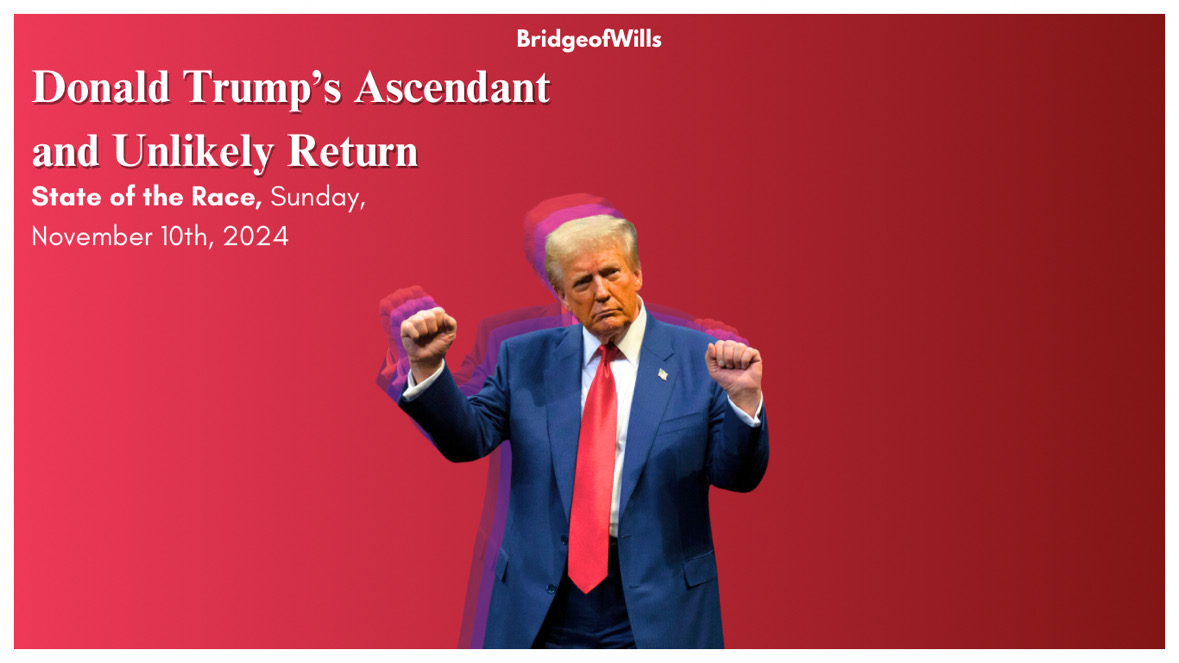
The 2024 election posed three questions; we’ve formulated our answers to two of the three questions posed. What happened? Donald Trump and Republicans triumphed over Democrats in a red tsunami that swept America. Why did Harris lose? She could not separate herself from Joe Biden and unite a fractured party corroded by years of animosity that created a campaign without a singular message that working-class Americans could resonate with. The final piece of the puzzle remains the Donald Trump question, which is simply a fascinating question. How could a candidate be mired in so much scandal, from criminal counts and convictions to baggage surrounding the events of January 6th to off-color comments that would end any run-of-the-mill Presidential candidate defying all odds to reach the office of the Presidency again? That multifaceted question could be answered by pointing out the weakness of Kamala Harris: that answer discredits the strengths of the Trump organization, and thus, it’s time to answer the question. Why did Donald Trump win?

An Unlikely Rise
It seemed scarcely imaginable that Donald Trump would emerge from the quandary that was January 6th. After being defeated for the Presidency in 2020 as a raging global pandemic consumed a re-election bid that was almost a sure thing for re-election, the situation was dire for the former President. After losing the Presidency for the Republicans in the backdrop of a worsening COVID-19 situation, on January 5th, the Democrats swept the two Georgia senate seats, ensuring that Republicans became the majority in the US Senate for at least the next two years. The mania would reach its zenith a mere 24 hours later when rioters stormed the capital on the command of the former President on the basis of his election fraud claims that were deemed to have no standing in more than 50 state and federal courts, including in the conservative Supreme Court where he had appointed three justices.
Rioters stormed the capitals in waves, attempting to halt the constitutional process of certifying the electoral votes: the day claimed four lives. It caused over 1.5 million in damages to the US Capitol. When the dust settled, the election was certified, and attempts to prevent it proved fruitless as the constitutional process proceeded forward that very night. January 20th came, and Joe Biden was inaugurated President. The newly christened former President didn’t show up: but Trump’s elections woes were just beginning.
Tonight and in the weeks to come, you will see evidence of what motivated this violence.
Liz Cheney
After the election, Trump faced a national probe by Congress spearheaded by Liz Cheney over his conduct on January 6th. In Georgia, there’s still an ongoing state lawsuit as to whether Trump violated Georgia election law by pressuring Georgia Secretary of State Brad Raffenspurger to “find” 11,780 votes: one more vote than Joe Biden’s margin of victory in the state. In addition, his fake elector scheme drew the ire of appointed DOJ prosecutor Jack Smith, who sought to punish him for his conduct during the 2020 election (this case is now winding down after his victory). The election was just one facet of his legal woes: a civil suit in New York federal court where writer E. Jean Carroll sued Trump for defamation and sexual assault, where Trump was ordered to pay her over 80 million dollars. In a criminal suit brought by New York Attorney General Letitia James, Donald Trump, and the Trump Organization were ordered to pay more than 450 million for money the court ruled was fraudulently obtained. His woes stacked and continued through election season, and the Democrats pounced on his “convicted felon” status to attract voters towards their cause, but in the face of all the troubles that Trump faced, he prevailed. The course of the campaign shows a Trump campaign that weathered the jovial Democratic exuberance of the late Summer into the early fall and that found its footing after remaining listless after President Biden dropped out of the race and defied all expectations.

Trump Vs. Biden
Despite those woes, Trump seemed on pace to win the election. While polls routinely underestimated him, he led in almost all of them against President Joe Biden. Biden was bogged down by an abysmal approval rating, a perception of a faltering economy (though according to the numbers, the US has bounced back from the COVID blight faster than almost any developed nation), and a border with record illegal crossings.
Trump’s victory seemed all but certain against Biden as even Biden’s own internal numbers spelled doom. The assassination attempt, the abysmal debate, and his convention all lifted him to a commanding lead against the Democrats. His message then was disciplined: hitting Biden on his age, on the economy, the border, foreign wars, and inflation. The message would undoubtedly be victorious with the pace the campaign was taking, but a complete reversion would happen when Biden announced his decision to retire from the race and endorse Vice President Harris for the nomination.

Trump Vs. Harris
After Biden dramatically exited the race following a disastrous debate in June, Trump had to face the reality that his messaging on Biden being old, demented, and terrible for the country wouldn’t work on the younger Harris. Trump took on the mantle as the oldest person in the race, and the sudden shift in Democratic strategy rendered the Trump campaign listless during the late summer stretch of the campaign. The campaign struggled with picturing Harris, and the numbers reflected a political paradigm that shifted on his head. In polling, Harris improved upon Biden’s numbers by 2-3% and managed to tie and exceed Trump within polling in the swing states and on the national stage.
The Harris momentum continued into and slightly after the debate, where numerous missteps by Trump, including the Springfield, Ohio gaffe relating to Haitian migrants eating “the cats, dogs and pets” of people that live there. However, the chefs in the Harris campaign began to burn the food: Harris rarely appeared before the media, and when she did, voters commented that her performance felt scripted. She hit the traditional circuit, 60 Minutes, NBC, and MSNBC, to increase her standing, but her answers began to lead the campaign astray. During The View interview, she mentioned how she wouldn’t do anything different than Biden; Harris also faltered on the Israel issue and continued to further incense the Arab community that began to drift away to third parties and Donald Trump. The period after the debate was the turning point of the campaign, where Trump managed to take Harris’s missteps and tie them to the unpopularity of the Biden administration.
The messaging was the fundamental pillar of Trump’s victory. Against the backdrop of the scattered brain Harris campaign that could not decide whether to embrace Obama’s optimism or the Biden campaign’s “democracy” message, which sought to scare Democrats into line, Trump stayed disciplined on the economy, the border, inflation, and ending wars abroad. Across the swing states and behind the off-color comments that drew the attention of traditional media, Trump stayed on message. In every speech, it would be a noun, verb, inflation; noun, verb; the border is in chaos; random reference, ending the war. Voters (especially white working-class voters) clamored for an administration that understood the kitchen table issues rather than one that gave affirmations as to how NATO was stronger. This election was dominated by kitchen table issues, and as the Biden administration sent billions to fund Israel and Ukraine as FEMA was running out of money at home to help rebuild after Hurricane Helene, they were attracted to the Trump message en masse where they felt that their problems were being heard. It can be said that the Trump campaign ran on extremely vague policies that held no real substance, but voters felt seen and heard as Trump spoke to their economic problems, as more than 70% of Americans live paycheck to paycheck. All that Harris publicly had to offer was tax cuts for business startups and a campaign that failed to transmit a cohesive economic message as the Trump campaign managed to do. And how he transmitted it made all the difference.

Trump Campaign Organization
The numbers paint a stark picture of how money was spent by both the Trump and Harris campaigns. By mid-October, Kamala Harris had managed to plow through 880 million of their one billion dollar campaign coffer by spending 654 million on advertising, more than 56 million on campaign staffing, and sending millions to campaign consultants to help reach a youth “get out the vote effort.” These efforts left the Harris campaign with 20 million dollars in debt. Donald Trump’s campaign was much more frugal in how it spent its money: Trump had managed to spend only 354 million by mid-October and spent 378 million on advertising during the whole election season from mid-July to election day. Trump also maintained a much smaller team, which he spent 9 million on staffing, relying on a ground campaign exported to Elon Musk’s America SuperPac. How the Trump campaign transmitted its message made all the difference and allowed for a much more efficient use of cash.
“I fully endorse President Trump”
Elon Musk
When Trump made an alliance with Elon Musk, he managed to transmit his message to millions practically free. Musk used X’s apparatus to pump right-wing content to millions of Americans, particularly younger voters who use social media in excess of 78%. Trump also utilized podcasters and streamers to get out his message: doing interviews with stars like Logan Paul, Joe Rogan, and Adin Ross and therefore was able to reach Gen Z voters (particularly Gen Z men) and vastly overperform with them during the election. Trump’s efforts bore fruit last Tuesday when Trump beat Harris with young males aged 18-29 by 2%, a 13% improvement from his standing in 2020. It wasn’t just young men either; shockingly, young women did not turn out for Harris. Trump managed to overperform by 11% with young women as compared to his 2020 performance.
The content farm (including a visit to McDonald’s and riding on a garbage truck) that Donald Trump and his allies were able to push was pivotal to pushing Donald Trump over the finish line and overperforming all expectations. Trump was his own ground game and his own media machine.

Trump and Democratic Expectations
The feeling was that the Democratic overperformance during the 2022 midterms and 2023 special elections would remain for the 2024 Presidential race. The overwhelming sentiment among many Democrats was that the Dobbs decision that overturned Roe v. Wade would be the undoing of Donald Trump; some early numbers indicated this. Polling by respected pollsters like Ann Seltzer showed a gender gap exceeding 20%, with women galvanized to vote for Kamala Harris nationwide. This sentiment worked for Democrats in the midterms: in a state like Pennsylvania, where they managed to win the senate race by over 5% and the Governor’s race by almost 15%. However, in 2024, the gender gap that Democrats failed to materialize, contrary to polling numbers, only managed to be just 10%.
Donald Trump managed to evade the jaws of the Democrat’s signature abortion issue by vacillating from position to position and devoting little time to it on a party platform, despite the multiple affirmations by Donald Trump that he was the one solely responsible for ending Roe v. Wade. Those expectations set by Democrats were crushed, as in swing districts, Trump managed to exceed all expectations and routinely gain 4-5% from his 2020 performance and sweep all seven battleground states.
Trump managed to form a historic coalition that included a record amount of Hispanics, African Americans, and young voters that propelled him to the finish line: he managed to create this coalition by pushing aside his enemies. During the Republican primary and general election season, it spelled dire circumstances for Trump, as even when Nikki Haley had dropped out of the race, she still received a routine 20% of the vote in the remaining primaries. This drew into question whether or not he could retain insurgent Republicans in his fold as Harris mounted a massive effort to target Haley Republicans; he managed to do it. When RFK was drawing votes away from him in the period prior to the June presidential debate, he managed to coax him in by offering him a position in his cabinet and consolidating his base of supporters to face a new Democratic nominee in July.

A Victorious Campaign
The Trump campaign emerged victorious in a substantial 312 electoral vote victory that lifted Republicans across the ballot to a Senate majority and a likely House majority (still has not been called). Trump honed in on a message of economic populism and relied upon new media to transmit his message to millions; it worked. Trump stayed disciplined in his message to Americans, a message that was made of four pivotal points: end foreign wars, inflation, the economy, and the border. By focusing on these kitchen table issues, he was able to defeat his own stumbles to become the next President of the United States in a remarkable political comeback for the ages.


Leave a Reply