
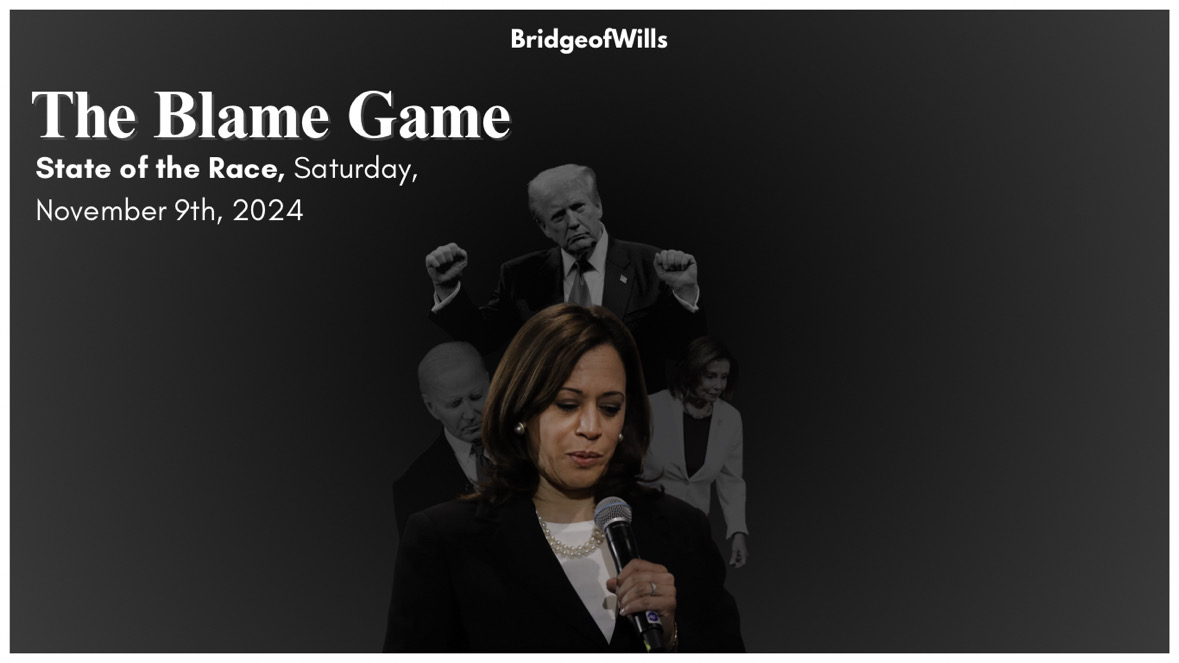
Yesterday, it was “What happened?” with the red tsunami submerging all corners of the country and defeating many Democrats with its sheer ferocity; today, it’s the blame game. Democrats everywhere are reeling as the initial shock fades with every passing hour, and anger replaces it: party leaders, strategists, and voters have begun pointing fingers as to who’s responsible for the devastating loss. Now, with the Trump era set to resume after a four-year pause into 2029, the question that wasn’t answered yesterday must be answered today: Why did Kamala Harris Lose?
President Joe Biden
A Kamala Harris defeat cannot be separated from the reality that stared down the Biden campaign in July, and that scene is easy to paint. That disastrous July that seemed so long ago is the fundamental pillar to the Harris campaign story; there was Biden, holed up in his Wilmington, Delaware home, suffering from a case of COVID-19 that precluded a swing through the battleground states that would save his floundering campaign. Numerous disasters had weathered the Biden campaign: the Trump assassination attempt, that disastrous debate where the President struggled to put a coherent messaging together, a collapsing approval rating, and the loss of faith from his fellow Democrats. The President held onto a fleeting hope that the “Great Lakes” path through the blue wall would save him as he began collapsing in the sunbelt states like Georgia and North Carolina. Senior campaign officials like Campaign Char Jen O’Malley Dillon assured senior Democrats that Biden’s path through the “Blue Wall” was alive despite shrinking numbers in the sunbelt states, but the numbers were dire.

The internal polling showed a disaster unfolding at the Presidential level where Biden was behind in every single “Great Lakes” battleground state, and he was beginning to lose ground in Minnesota, Virginia, New Mexico, New Hampshire, New Jersey, and Maine: solidly democratic states. More and more voters thought he was not mentally capable of handling the Presidency for another four years; Democrats began to understand the sobering reality that Biden would lose in a landslide. President Obama, Nancy Pelosi and Chuck Schumer began to ramp up the pressure on the President to withdraw from the race easily, or face the music in the hard way. The President held on to his mettle and was determined not to let those who refused him a chance to run in 2016 tank his opportunity for a second term in 2024, but then and there, holed up in his mansion, he faced crushing reality. Dramatically entering the room on a Saturday evening, Steve Richetti and Mike Donolin, his closest aides since his 1970s campaign, carried numbers from a dramatically slowed fundraising operation and collapsing standing across the country; so, the belabored Biden 1:46 pm on Sunday, dropped out of the race.
The race was up in the air. Would there be a primary? Who would be the nominee? Those questions were quickly quashed as Biden fully endorsed Kamala Harris and urged party delegates to unite around the Harris campaign. Biden was on the Harris train all the way, it seemed. But was he truly?
He wasn’t
For the 107 days that Harris had to run the campaign when Biden rarely turned up to offer his support, it seemed complete. But behind the scenes, it told stories of a bitterly bruised President sour that his party had pushed him aside after he had won the support of Democrats in a national party. For those 107 days, the influx of news reports saying how Biden aides pointed at flaws in the Harris campaign and the repeated efforts she was making to distance herself from President Biden: saying at multiple junctions that she was not Joe Biden and then having to walk back as she did on The View after the pressure from the White House ramped up to an extreme. Biden did not play the fool, and when asked about Harris’s role in the administration, he stated that she was a partner in every decision he had made. With his collapsing approval ratings on the national level (approvals that now stand at almost 20% underwater, according to 538), the association Biden made provided plenty of fodder for the Trump campaign. Then there was the campaign trail.
There is not a thing that comes to mind in terms of — and I’ve been a part of most of the decisions that have had impact
Kamala Harris on the View
On the trail, Biden was absent. After having campaigned with Harris once on Labor Day, he was a no-show: Harris had purposely designed it that way, keeping him away from the trail so as not to harm her. But Biden had no intention of rallying for her either way, as the news stories coming out of Axios and other outlets pointed at an incensed Biden: and whenever Biden did rear his head into the field of action, it served to harm the Harris campaign. From jokingly wearing a Trump 2024 hat to calling Trump supporters “garbage” modeled after the “basket of deplorables” comment that hampered Hillary Clinton, Biden served an inactive role that showed that he wasn’t truly over how Democrats have pushed him aside; he refused to speak to Nancy Pelosi, shunned Chuck Schumer and maintained cold air with Obama. Biden wasn’t happy.
With the election in the books, Democrats point to Biden and say that he should’ve never run for re-election and have announced his intention off the heels of Democrat victory in the 2022 midterm elections. In an NYT Editorial, Nancy Pelosi laid the blame solely at Biden’s feet for not dropping and allowing a competitive primary process that would’ve sharpened Harris’s skills as a candidate and potentially allowed a stronger candidate. Harris’s allies themselves have taken to attacking the President for his role in “sabotaging” her campaign, but Biden has shrugged them off, heralding his Presidency as accomplished and historic in a Rose Garden speech that assured Americans of a peaceful transfer of power.
Biden is inextricably tied to Harris.

Harris Herself
Ascending to the top of the ticket was a whirlwind for Harris: from dropping out of the Democratic primary just four years prior before a single state held its primary to now the zenith of the Democratic party as its choice nominee to defeat Donald Trump. The first days of her campaign seemed all sunshine and rainbows as she fundraised record amounts of money and raced to create an organization in the battleground states. Her selection infused much-needed life into the Democratic organization, but behind the whirlwind, there appeared a crossroads for Harris. How could she properly create a campaign organization from the remnants of the Biden campaign while delicately walking the fine line of tying herself to the ex nominee: what emerged from the quagmire was a hodgepodge of her allies and some of the Biden organization, but immediately, she set a different tone from Biden.
Whereas Biden attempted to scare Democrats with the potential dangers of a Trump second term to keep them in line, Harris focused on hope and renewal, echoing the sentiment of the Obama 2008 campaign. For a while, polling improved, and she was lifted by the hopes of millions of Democrats as numbers across the ballot improved. The DNC was jovial as Democrats celebrated Harris, and the campaign stormed right along to the September Presidential Debate where she received a solid boost, but the fundamental problem quickly arose with the campaign she had assembled: messaging.
The campaign failed to rally around a single slogan: too many cooks in the kitchen failed against the tested Trump motto that has ingrained itself in Americans that have supported him: Make America Great Again. An easily digestible message that voters rally around was absent from her campaign and the turnout dropped as millions of Biden voters (more than ten million) failed to turn out for her as they did for Biden in 2020. The easily digestible message was muddled in the mix of contrasting visions; where Biden ran on a dark vision of a second Trump presidency, Harris ran on optimism that slowly morphed itself into a Frankenstein of optimism and despair. Harris’s message failed to resonate as she oscillated between stances, as she changed positions on issues like fracking in an attempt to appeal where voters found it disingenuous in the data; voters in excess of 50% struggled to find Kamala Harris’s real positions. This seeped into her stance on Gaza, from strongly supporting Israel to toeing the line in condemning Israel’s actions in the West Bank.

The outcome of this election is not what we wanted, not what we fought for, not what we voted for
Kamala Harris Concession
Inflation and Immigration
The fundamental problems of the Harris campaign and the batting issues of the Trump campaign were inflation and immigration. On inflation, Trump consistently held a double digit advantage on the issue that millions of Americans held as the most important issue during the election season. Despite numerous reports from the Fed stating that inflation was on the steady decline with every passing report, Americans didn’t feel that way. Across America, citizens saw prices increase for basic necessities that hit the wallets as 78% of Americans live paycheck to paycheck. Despite early exit polls showing a tighter race in regards to the economy, Trump won voters focused on the economy by greater than 60% in the final tally. Beyond democracy, abortion and social issues: Trump dominated on the economy, and proved that it really is “the economy, stupid.” But this wasn’t the only issue he hammered.
Immigration was another bane on the side of the Harris campaign. There was a mass sentiment that pervaded voters that Kamala Harris was the border czar and the millions that poured through the border was squarely Harris and Bidens’ fault. Biden tapped Harris to head an initiative called the “Roots Causes Strategy” to stunt immigration by improving immigrant situations at home. However, a record number of immigrants flooded through the southern border. Harris attempted to tie the border to Donald Trump and his tanking of a bipartisan border school: but the perception against Biden and Harris had fermented over years, and a singular bill barely made a dent into what voters thought was weakness on the part of Democrats on the border.

Conclusion
In the end, Harris failed on numerous fronts to stop the baggage that had accumulated against Democrats and the Biden administration. She could not separate herself from the unpopular Joe Biden, or hone in a message that resonated with voters across America. The final destruction of the Obama coalition and the rise of a diverse Republican one led to a substantial electoral defeat at the top of the ticket; in the end, Harris lost, and Trump won. And tomorrow we’ll see why Trump won.


Leave a Reply