
America has always prided itself on its strategic alliances and devotion to its allies worldwide. In the post-World War II era, America emerged as a hegemon of global power rivaled only by the likes of the Soviet Union. Still, that rivalship fell, too, after the American victory in the Cold War. Entering into the post-Cold War, America held a strategic positioning so strong such that it was the arbiter of global power in the world, but entering into this new period of uncertainty concerning shifting dynamics brought upon by the onset of a strengthened China this new period is marked with a degree of great uncertainty. In this great uncertainty, however, one constant is America’s support for NATO. NATO, created as a defense mechanism to avoid another great conflict on the European continent by treating an attack on one as an attack on all, has been greatly effective as a deterrent to conflict on the European continent. As NATO enters its 75th anniversary, it is necessary to comment on the enduring legacy that it has created to promote democracy and stability not just within Europe, but throughout the world.

Inception of NATO
Following the Allied victory in World War Two and a series of conferences at Yalta, Potsdam, and Tehran, the discord that emerged between the big three (The Soviet Union, Britain, and the United States) was evident. Leaders from the United States and Great Britain poised themselves as strong defenders of democracy as the prevailing philosophy that ought to govern post-war Europe; with this strong commitment to democracy, the Western leaders pushed Stalin to agree that he would guarantee free and fair elections in their Eastern Europe satellite states. It quickly became evident that Stalin had no interest in promoting any sort of democratic principle within his “iron curtain,” and Western nations began to look worryingly at the onslaught of Soviet terror on the continent. The Western panic was soon to be confirmed by Soviet action in 1947 -1948; from the raging Greek Civil War and the Turkish Crisis, it was clear Stalin had no intention of keeping his lust for greater influence contained within the confines of the Eastern bloc.
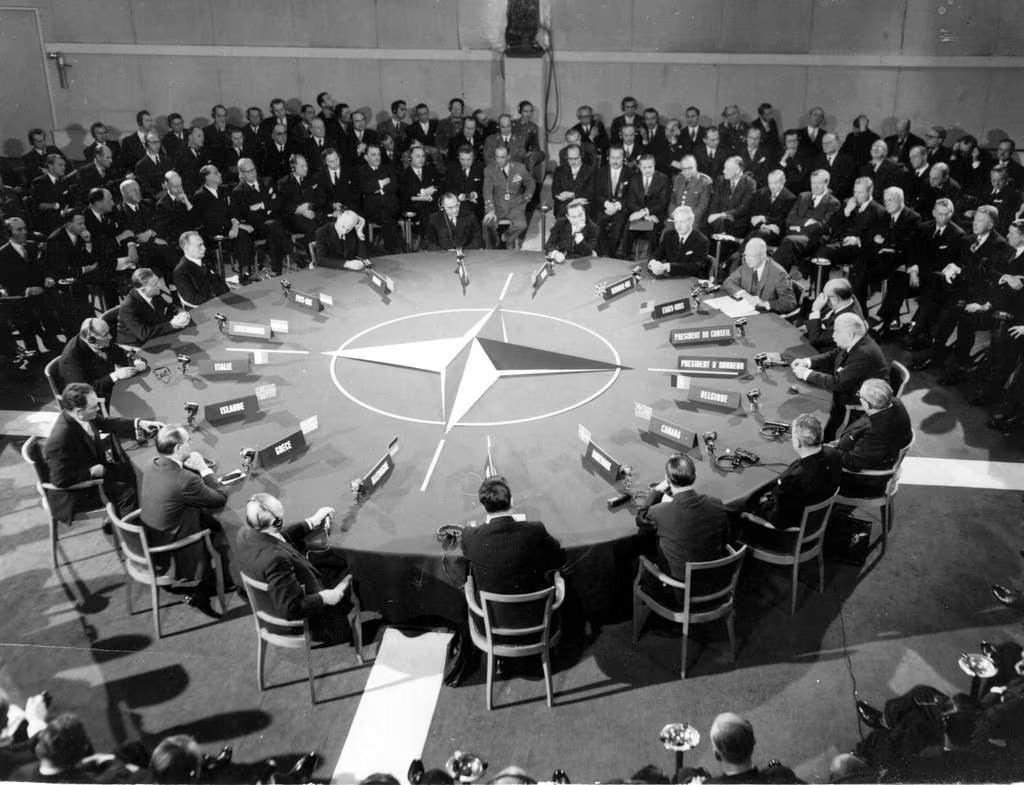
The tension exploded in 1948 as Stalin called for a blockade of Western Berlin that brought France, Great Britain, and the United States close to a third world war. However, through the ingenuity and resolve of the heroic Berlin Airlift, a global conflict was avoided right then and there. This narrow avoidance of another catastrophic war right off the heels of the last one didn’t fool Western leaders into thinking that the red menace’s threat ended in Berlin: they sprung into action. Great Britain, France, and Luxembourg signed the Brussels Treaty in March 1948 that provided the framework of “collective security.” In conjunction, the Truman administration instituted a peacetime draft and legislation passed through Congress to begin negotiations for a security treaty with Western Europe that adhered to the UN Charter but existed outside the Security Council. After rounds of negotiation, the North Atlantic Treaty was born in 1949.
Brief Cold War History
The ink had barely dried on the treaty as the alliance was sprung right into the heat of action; the Korean Crisis erupted in June 1950, and the war’s effect on the alliance was stark. The increased urgency and necessity for NATO to create a unified military structure and headquarters to quickly respond to threats was recognized and acted upon in post-haste. Military headquarters were stationed in the Parisian suburb of Rocquencourt, near Versailles. Dwight Eisenhower was selected as the first Supreme Allied Commander of Europe. This was later supplanted with a permanent civilian secretariat in Paris, with NATO’s first Secretary General being Lord Ismay of the United Kingdom.
NATO continued to serve a crucial role in the Cold War conflict, expanding membership into Greece, Turkey, and West Germany and creating a “nuclear umbrella” against the onslaught of the Soviet Union’s machinations in Europe and worldwide. The Soviet Union would eventually collapse after its failure to keep up with Western advancement in the arms race, but NATO’s influence did not end with the collapse of the Soviet Union; in fact, it’s arguable to say that in the postwar era, its influence only grew.
Post-War Era and Modern Role
Following the Soviet collapse, NATO emerged with a special role: transitioning to a “cooperative-security” role to foster dialogue and cooperation with former Soviet Satellites that were newly freed, fulfilling this objective by establishing the North Atlantic Cooperation Council in 1991. While this role was certainly important, the drastic expansion of influence came with the policy decision to manage conflict areas in the European periphery. This interventionist foreign policy came to a head when NATO officially first used military force in the disintegrating Yugoslavia in the Balkans. NATO staged air strikes against Bosnian Serbs and aided in the development of the Dayton Accords, which sought to establish the bounds of sovereignty within this troubled region. Again, in 1999, NATO intervened against Serbia to stop the ethnic cleansing of the Muslim Albanian province of Kosovo.
September 11th would be another pivot point that would end the relative peace of the post-Cold War era; after America pledged to seek and destroy the terrorists that had attacked the country, NATO invoked Article 5 in defense of its allies, pledging full support in America’s fight. The death of the post-war era came with another complication: Russia’sincreasing hostility.
Russia entered the 21st century as a collaborator with NATO, working on arms limitations and working together in efforts to end international terrorism. The ascension of Vladimir Putin complicated things, and a disintegration of any goodwill left from the post-war period occurred when Putin invaded Georgia in 2008; NATO sprung into action to create a NATO-Georgia commission to accelerate Georgia’s admission into the NATO alliance, further aggravating Putin. This action paled in comparison to Putin’s annexation and invasion of Crimea in 2014, an action that served as a prelude to his ultimate goal, a Russian annexation of Ukraine, a premonition that came to pass in 2021.
Today and Conclusion
The Russian Invasion of Ukraine came off the heels of an embarrassing retreat from Afghanistan in the United States, a move interpreted as political weakness and a green light for Putin to invade Russia. This action wouldn’t be met with passive indifference but with strong indignation: allies sprung into action, pledging billions of dollars to help Ukraine repel the old red menace and maintain its sovereignty as a state. The political miscalculation that Putin erred in has served to box him inside of a corner, and any defensive buffer they had against NATO quickly evaporated as Finland and Sweden joined NATO despite Turkish objection to adding more than 800 miles of frontier into NATO. Allies met in Washington this week to commemorate the 75th anniversary of NATO, and given its long history of defense against the forces of totalitarianism, it is wholly and completely justified.


Leave a Reply